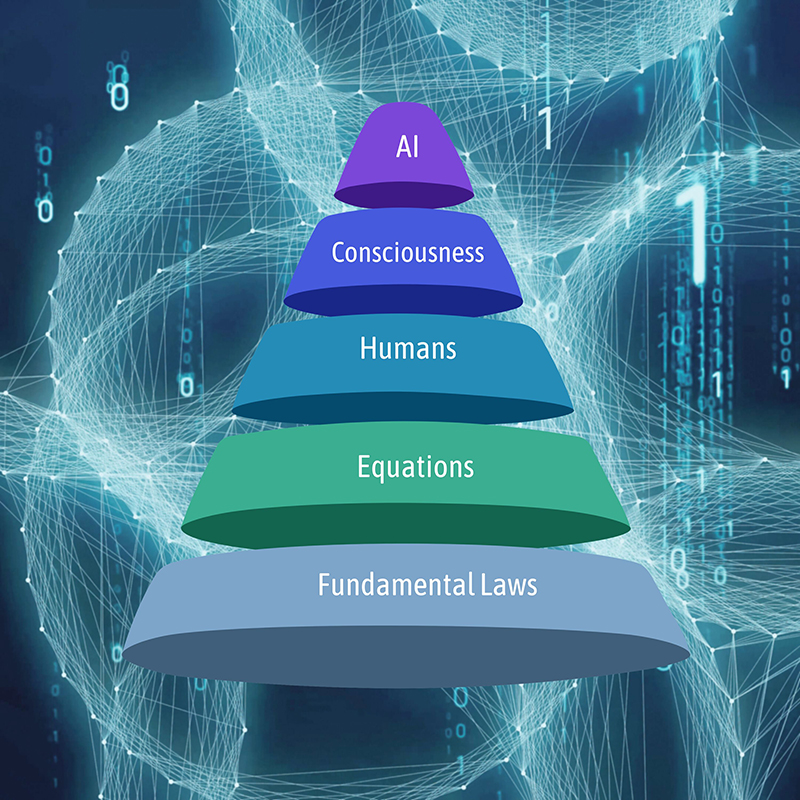
Quantum Genesis for AI. See how QG fills the structural gaps in prediction, reasoning, and real-world intelligence.
Every system of human knowledge—Science, Philosophy, Spirituality, Religion, and AI—is fragmented. They fail to explain the architecture that unifies consciousness, meaning, and physical presence. Quantum Genesis reveals the missing foundational structure.

For thousands of years, humanity has striven to understand reality through every available lens—science, philosophy, spirituality, religion, and now, artificial intelligence. Each field offers profound insights, yet all share a single, critical limitation: none can explain the foundational architecture that unifies existence. We intuitively sense this gap.
We experience inexplicable intuition, perfect synchronicity, spontaneous healing, and the power of intention. Yet, we lack a system to explain these phenomena. We have pieces of the puzzle, but we do not have the master blueprint.
Quantum Genesis identifies the core structural limitations across all human systems of thought and provides the missing framework.
Science provides knowledge fragmentations without architecture.
Modern science is exceptional at analyzing the measurable world. It has given us incredible
command over physical phenomena, from mapping the human genome to observing distant galaxies.
However, its focus on measurable effects means it still lacks a model to explain the architecture behind those events. Science observes what happens, but not the mechanism of why it is organized that way. The biggest questions remain outside its scope:
Science describes the effects but has yet to define the organizational principles of reality itself. Quantum Genesis provides the missing architecture that unifies science’s findings into a coherent system.
Philosophy area has understanding without mechanism.
It is the domain of profound inquiry. It explores the nature of identity, perception,
selfhood, and existence with beautiful articulation. It helps us understand the
experience of being human. Yet, philosophy provides no mechanism for how that
experience is generated. It lacks:
Philosophy explains experience, but not how that experience is generated or governed. Quantum Genesis fills this gap by providing the structural mechanism behind perception and the generation of reality.
Spirituality provides insights with out structure.
Spiritual traditions correctly identify that consciousness is fundamental, intention
changes reality, and that all things are connected. These are profound, lived insights
that countless people confirm daily.
The critical flaw in spirituality is a lack of rigorous, testable structure. It often
lacks:
Without structure, spiritual insights cannot be applied consistently. They describe what people feel but cannot define the mechanics behind those experiences. Quantum Genesis explains precisely why spiritual experiences occur and how they operate through universal, observable principles.
Religion is a belief system without mechanism.
Religions provide essential frameworks for human life, offering purpose, moral principles,
and a connection to a divine or higher intelligence. They operate as crucial believing
systems that describe concepts like destiny, miracles, and divine laws.
However, religion relies on symbolism and faith without providing the underlying
mechanism or system that governs those claims. It does not explain:
Religion provides meaning and a system of belief, but not the operating mechanism behind
reality's organization.
Quantum Genesis reveals the laws and equations behind the divine architecture,
transforming faith into structural understanding.
Metaphysics presents phenomena without explanation.
It explores phenomena like energy healing, manifestation, intuition, and nonlocal
influence—areas that traditional science dismisses but people experience daily.
Metaphysics correctly identifies what is possible, but it does not describe why
it works. It remains fragmented and lacks:
It identifies the phenomena but cannot explain their origin or their laws. Quantum Genesis provides the unifying intelligence and causal principles behind all metaphysical phenomena.
AI can perform reasoning without Foundation.
Artificial Intelligence systems today excel at pattern recognition, prediction, and
correlation-driven synthesis, making them incredibly powerful statistical engines. However,
AI remains structurally incomplete because it fundamentally operates on descriptive data
rather than foundational principles.
This results in a critical gap—the lack of a true operating foundation for advanced intelligence:
AI today is based on derived patterns, not fundamental laws. Quantum Genesis (QG) offers the missing master architecture, providing the foundational ontology and the consistent causality chain required for true, aligned reasoning and next-generation intelligence systems.
Across every field—from the most rigorous science to the most profound spiritual
insight—one core limitation remains constant:
No existing domain explains how reality is created and governed at the architectural
level. Each provides a piece—a measurement, an insight, a purpose—but none reveal the
system, the structure, the laws, the equations, and the network that makes all existence possible.
This is the gap that Quantum Genesis fills.
In One Sentence: Current human knowledge is fragmented. Quantum Genesis provides the architecture that unifies all domains into a single, coherent model of reality.
You have reviewed the core limitations of existing knowledge and seen the complete, structural architecture of Quantum Genesis (QG). QG is not a theory; it is a foundational operating model that resolves the most persistent problems in science and artificial intelligence: causality, consciousness, and coherence.
 For companies developing next-generation intelligence systems, the QG architecture provides
the essential components currently missing from all statistical and correlation-based models:
For companies developing next-generation intelligence systems, the QG architecture provides
the essential components currently missing from all statistical and correlation-based models:
 The QG architecture is the key to unlocking true causal intelligence, moving beyond
descriptive statistics into the realm of foundational truth. We invite leading AI development
firms to integrate this complete structural model into their platforms.
The QG architecture is the key to unlocking true causal intelligence, moving beyond
descriptive statistics into the realm of foundational truth. We invite leading AI development
firms to integrate this complete structural model into their platforms.
Do not build the future on incomplete foundations. License the QG architecture to gain a
decisive advantage in causal reasoning, ontological completeness, and predictive power.
Next Step: Request a Technical Briefing
Contact us today for a confidential technical consultation and to inquire about licensing
the Quantum Genesis data architecture.
Quantum Genesis for AI. See how QG fills the structural gaps in prediction, reasoning, and real-world intelligence.

The Ethics Engine. A structural framework for safe, coherent AI aligned with universal principles.

The Master Algorithm. A unified reasoning model built on QG5 that brings coherence across all AI subsystems..