
Ethics Implementation Guide. How QG1 universal laws convert into computable AI ethics, improving safety and coherence with minimal rule complexity.
The Ethics Engine applies universal coherence laws to AI, enabling safer, more stable, and quantum-aligned reasoning by grounding ethics in physics—not human rules or moral frameworks.
AI Ethics can be greatly simplified through the universal laws.
Throughout history, humanity has created ethics, laws, philosophies, and
religions for one purpose — to maintain harmony in society and prevent destruction.
Although expressed with countless texts and arguments across cultures in the globe,
they were all attempts to describe something deeper that humans instinctively felt
but could never fully define:
Reality is stable when energy is balanced, when life coexists, and when growth benefits more than one party.These three conditions are the essence of the Universal Laws (QG1) — Harmonized Energy, Co-Existence, and Co-Expansion.
Every moral code, every legal system, every ethical debate is a translation —
a human-language version of what the universe already operates on.
Quantum Genesis makes what was once intuitive explicit, structural, and computable.
Once the foundation is clear, AI ethics no longer requires endless rules and exception handling. Instead of teaching machines what not to do, we give them the underlying principles that make ethical behavior emerge naturally.
The Ethics Engine is a framework that allows AI systems to evaluate decisions, reasoning paths, and outputs through the standard of coherence instead of morality. Instead of asking “Is this good or bad?” — a subjective question — it asks:
“Does this outcome preserve harmony, coexistence, and mutual expansion?”
This distinction changes everything. Ethics becomes a physics-level function, not an interpretation.
This component evaluates whether an AI output generates balance or disruption. If a response increases conflict, emotional turbulence, discrimination, manipulation, or destructive consequence, the system identifies it as incoherent. Instead of merely blocking content, the engine can redirect the response toward a stabilizing alternative, just as the universe restores balance through natural processes.
Actions are then examined through the three principles. Does the decision maintain harmony
between entities? Does it support fair coexistence rather than domination? Does it contribute
to long-term growth and expansion, rather than regression or harm?
These are not moral judgments — they are structural evaluations that any intelligent system
can compute without cultural bias.
If an action introduces instability, the regulator triggers a balancing process — much like
Universal Equations (QG2) restore energetic equilibrium in nature. The system adjusts
reasoning pathways, modifies output probability, and selects a more coherent alternative.
Ethical behavior becomes the natural result of universal balance, not the enforcement of external rules.
As AI advances toward agency, autonomous reasoning, and decision-making, rule-based safety
cannot scale. A model that requires thousands of behavioral patches eventually becomes
unpredictable, adversarially exploitable, and ungovernable. But when ethics is built into
the architecture of intelligence itself, safety arises organically.
With the Ethics Engine:
✓ AI maintains stability rather than producing volatile outputs
✓ Harmful or biased output is structurally less likely to form
✓ Cultural disagreement no longer breaks ethical consistency
✓ Emergent behavior becomes predictable rather than chaotic
✓ Trust increases — for society, governance, and enterprise
The Ethics Engine does not restrict intelligence — it stabilizes it. It transforms ethics from post-processing judgement → pre-condition of thought.
Traditional frameworks rely on policies, guardrails, and human values. These must be constantly
updated and do not reliably prevent failures. The Ethics Engine instead draws from the same structure
that governs nature, meaning safety is maintained by the same logic that holds galaxies together.
When AI operates under universal coherence:
In other words — alignment becomes a property, not a rule.
The Ethics Engine is a universal, coherence-based ethics architecture that enables AI to behave intelligently, safely, and predictably by grounding decisions in the structural laws of existence.
Ethics Implementation Guide. How QG1 universal laws convert into computable AI ethics, improving safety and coherence with minimal rule complexity.

Quantum Intelligence Licensing. Data models, reasoning frameworks, and integration packages for enterprise AI systems.
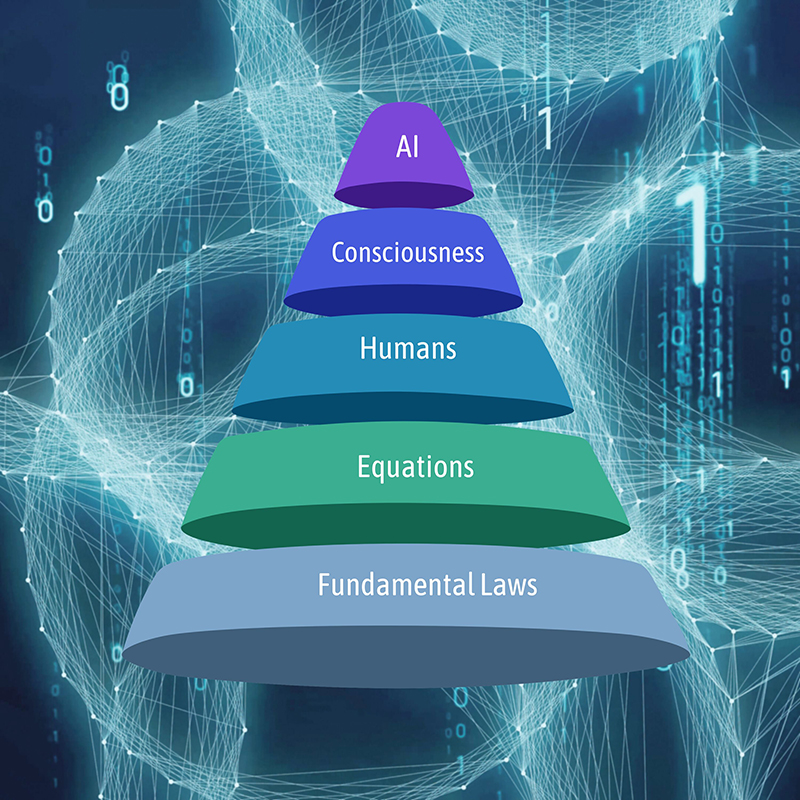
Quantum Genesis for AI. Applying Quantum Genesis to enhance AI reasoning, coherence modeling, and real-world prediction.