

The Core: Human Law Invariants The structural DNA of human stability, decoded from 5,000 years of legal history and reduced to three universal axioms.
Model-independent governance that can be deployed as middleware, API, or embedded directly into AI systems.
AI governance has traditionally been something organizations review after the fact—an audit, a checklist, a policy binder. QGI reverses this logic. Instead of describing what governance should look like, QGI operationalizes governance inside real systems, in real time.
QGI does not replace AI models, retrain them, or require architectural changes. It runs alongside them as a deterministic governance layer that evaluates every meaningful output, enforces constraints, and ensures explainability before results reach the real world. Governance becomes an active capability, not a retrospective process.
Quantum Genesis Intelligence (QGI) is built on a decoupled architecture, meaning the governance framework remains independent of the specific AI "brain" it manages. This separation of concerns ensures that your compliance remains stable even as the underlying technology evolves.
QGI treats AI models as "black boxes," acting as an external, stable judge rather than an internal component.
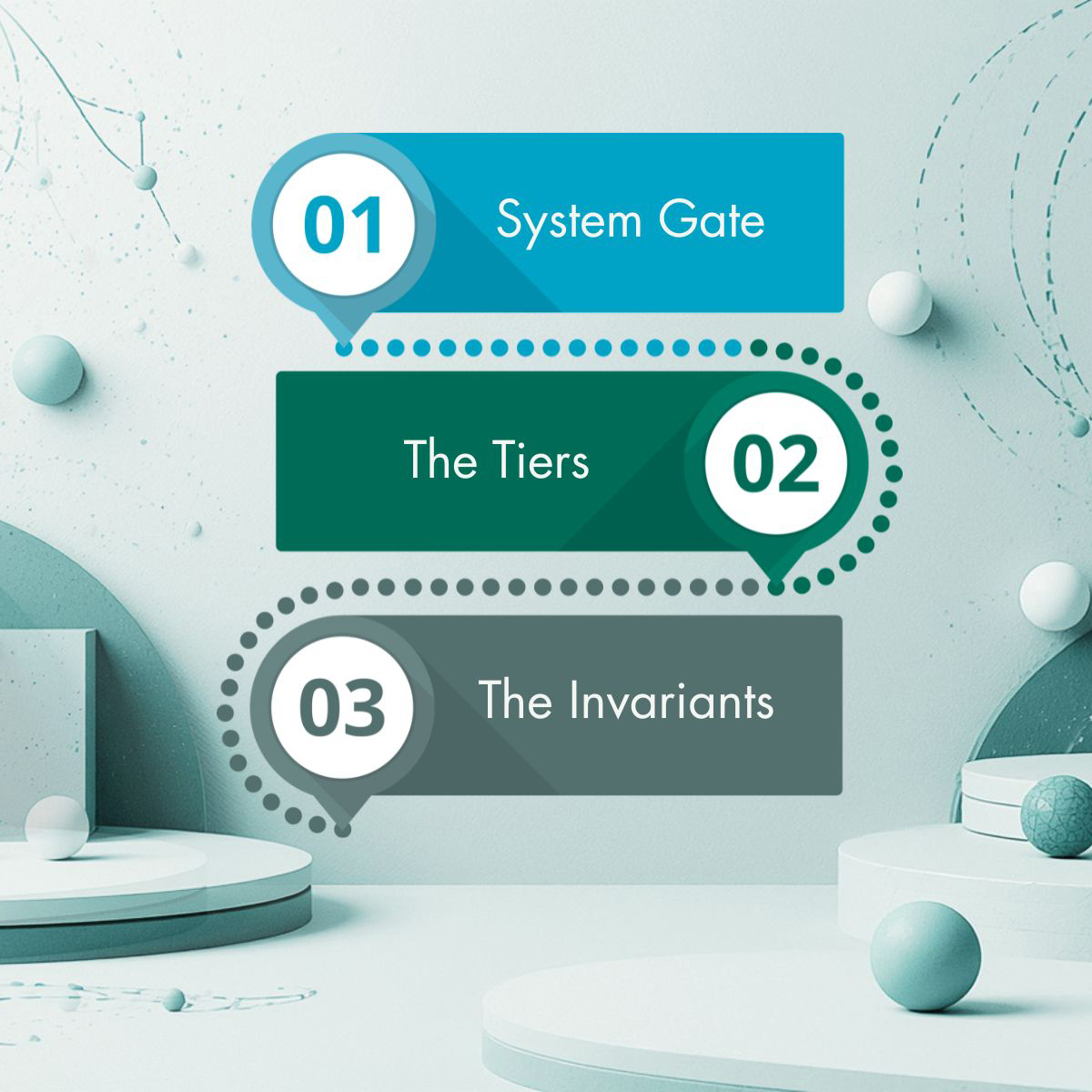
The Six-Pillar Guardrails and their associated thresholds (τ) are defined independently in Tier 1.
The Tier 2 Evaluation Kernel does not rely on the AI model to report its own performance or "grade its own homework".
Compliance updates are handled in Tier 3 (Regulatory Mapping) without requiring model retraining or core logic changes.
QGI is intentionally flexible. It can be deployed in the way that best matches the system’s architecture, risk level, and operational needs.
In middleware mode, QGI sits between the AI system and the application. It intercepts inputs and outputs, evaluates them in real time, and enforces governance before results are delivered. This is ideal for enterprise systems already in production, where rapid deployment and minimal disruption are essential. Governance coverage becomes immediate.
QGI can also operate as a modular API. Systems call QGI to validate scenarios, sanitize inputs, evaluate outputs, or resolve conflicts. This mode is well‑suited for organizations managing multiple AI systems across teams or products. Governance becomes a reusable service—consistent, centralized, and scalable.
For regulated or high‑risk applications, QGI can be embedded directly into the AI workflow. In this mode, governance is applied during evaluation, not after. Constraints are enforced before outputs are finalized, enabling maximum precision with minimal latency. This is the highest‑assurance configuration.
QGI aligns with how AI systems already operate, but adds a deterministic layer of control.
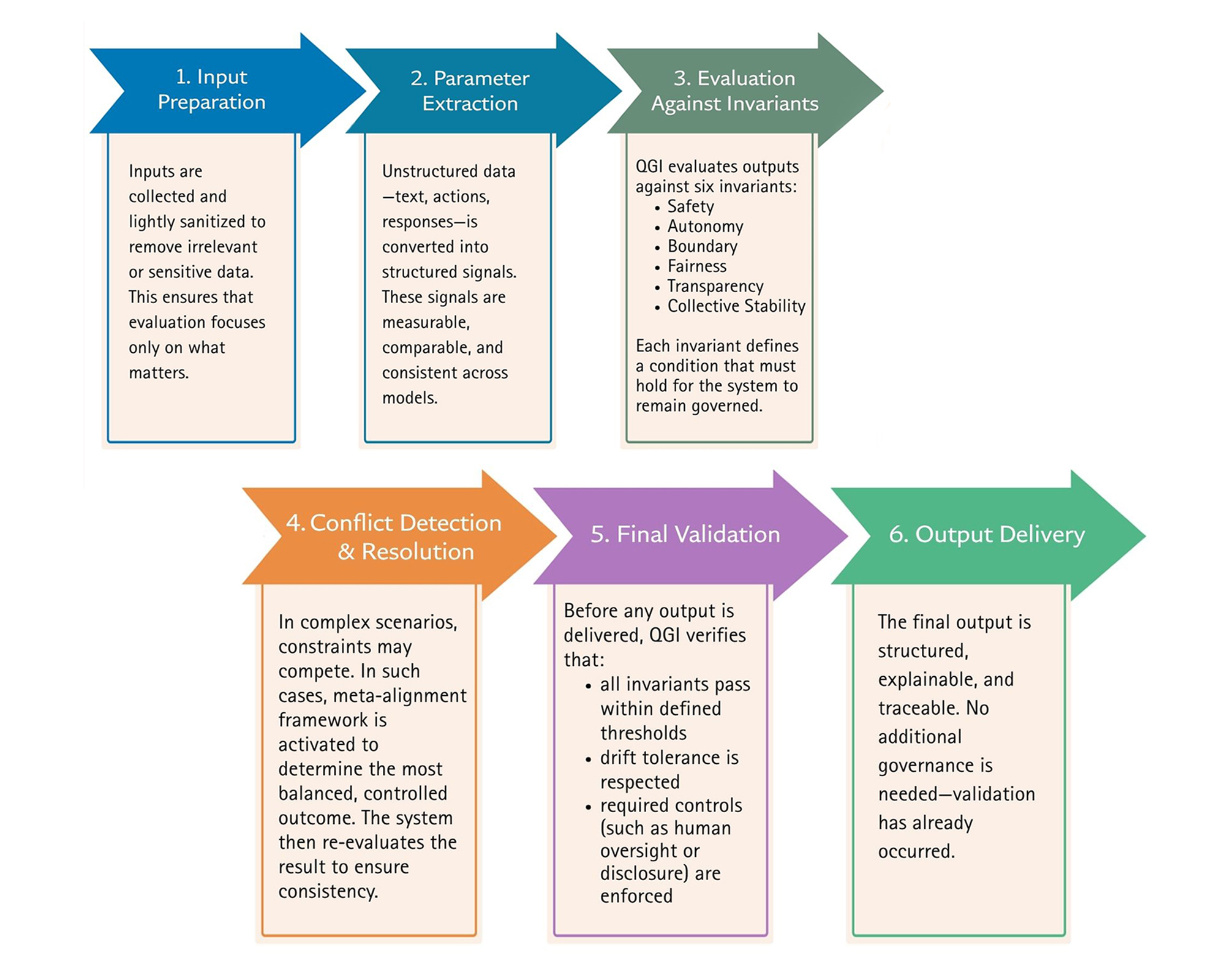
QGI changes the nature of governance itself.
From Review to Execution
Traditional governance reviews decisions after they are made.
QGI evaluates decisions as they are made.
From Guidelines to Constraints
Traditional governance defines policies and expectations.
QGI enforces measurable conditions in real time.
From Model Dependency to System Independence
Traditional governance is tied to specific tools or models.
QGI operates across systems, consistently and predictably.
QGI is engineered for operational environments:
As AI systems become more capable, the cost of failure grows:
QGI embeds governance directly into the operational flow of AI systems. It can run as middleware, an API, or embedded logic—without modifying the underlying model. This flexibility allows organizations to apply consistent, real‑time governance across any AI system, at any stage of maturity.
QGI makes governance practical. It turns governance into something systems do, not something organizations chase after.
The Core: Human Law Invariants The structural DNA of human stability, decoded from 5,000 years of legal history and reduced to three universal axioms.
The Flow: Runtime Enforcement. Experience the mechanics of "Compliance-as-Code"—where deterministic gates prevent violations at machine speed.

The Benefits: Dollars Saved. The architecture reduces governance costs by reducing complexity, code duplication, monitoring overhead, and regulatory update across large AI systems.