
The Project: Government Infrastructure. This project applies QGI to infrastructure prioritization, enabling transparent, consistent, and accountable public investment decisions.
A Governance-First Portfolio Hiring System
It will replace opaque algorithmic screening with portfolio-based evaluation,
allowing candidates to demonstrate reasoning through transparent scenario responses.

Hiring has increasingly become an automated process. Many organizations now rely on machine screening tools that evaluate resumes, analyze behavioral signals, or rank candidates before any human interaction occurs. In many cases, applicants are not aware that automated systems are filtering their applications, nor do they have the ability to understand how those decisions are made.
Over the past several years, these practices have drawn growing scrutiny from regulators, courts, and the public. Lawsuits and investigations involving automated hiring systems have raised concerns about transparency, fairness, and consent. In some cases, algorithmic screening tools have been accused of reinforcing bias or rejecting qualified candidates without meaningful explanation. These developments highlight a fundamental tension: while organizations need efficient hiring processes, applicants deserve transparency and a fair opportunity to demonstrate their abilities.
These challenges point to the need for a different approach.
QGI Portfolio Hiring proposes a governance-first model for candidate evaluation. Instead of silently filtering applicants through opaque algorithms, the system invites candidates to demonstrate how they think, reason, and respond to realistic scenarios relevant to the role.
The goal is not to automate hiring decisions. The goal is to create structured evidence for human decision-making.
At the center of the system is a structured evaluation framework built around eight dimensions that reflect the fundamental questions behind hiring decisions. Organizations define role-specific prompts and scenarios across configurable areas such as:
Based on these inputs, the system dynamically generates contextual questions and work-like scenarios that candidates respond to. Their answers form a structured portfolio of reasoning, explanations, and decision processes.
This portfolio becomes a shared artifact between the applicant and the hiring organization. Instead of a hidden score or automated rejection, the evaluation produces a transparent record of how a candidate approaches problems and communicates decisions.
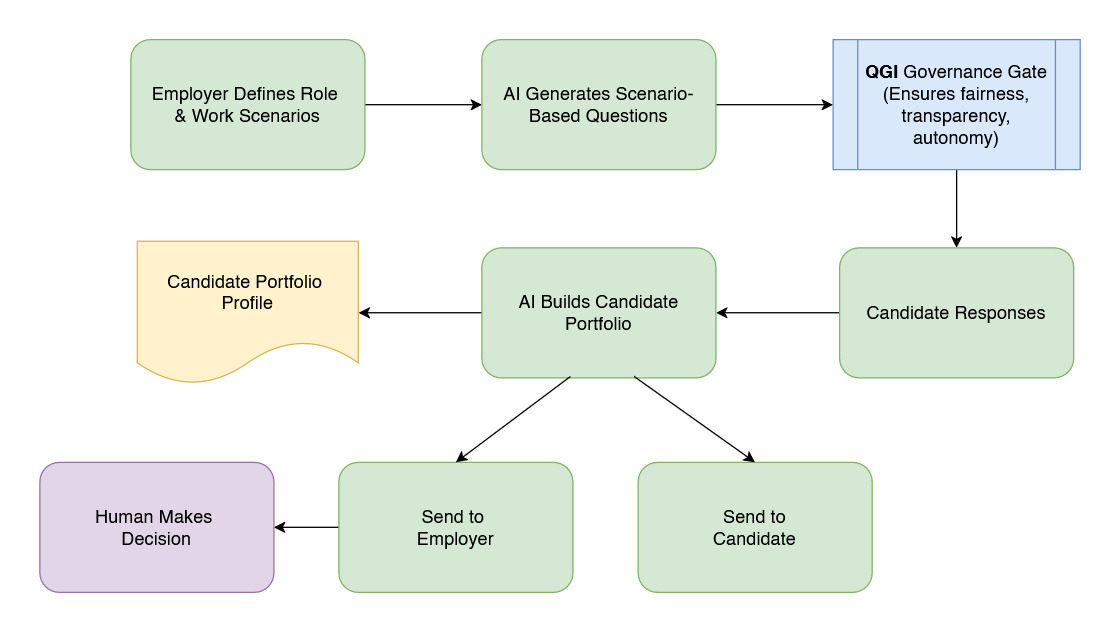
All scenario generation within the system passes through the QGI governance framework before it is presented to candidates. This ensures that evaluation prompts meet governance constraints such as transparency, fairness, and respect for applicant autonomy.
The purpose of this governance layer is simple: AI should assist the hiring process without becoming an invisible decision-maker.
By applying governance constraints at the design stage, QGI Portfolio Hiring helps organizations avoid the risks associated with opaque algorithmic screening.
The final hiring decision always remains with human evaluators.
What the system provides is a richer basis for those decisions: a portfolio that captures
how candidates reason through realistic scenarios rather than relying solely on resumes
or keyword matching.
This approach creates a more transparent process for applicants and a more informative evaluation framework for organizations.
In an era where automated hiring systems are increasingly questioned, QGI Portfolio Hiring explores an alternative path—one where technology supports fair evaluation without replacing human judgment.
This is the visual interpretation of QGI Portfolio Hiring System.
There are four roles involved: Organization, AI Processor, QGI Governance, and Candidate.
Phase 1: The Design & Validation (Steps 1–3)
The process begins with the organization choosing which of the 8 Dimensions
matter most for the role. Before a candidate even sees a question, QGI validates
the AI-generated scenarios.
The Goal: To ensure the "test" is relevant and hasn't introduced accidental bias
or unfair complexity before it reaches the human.
Phase 2: The Blind Evaluation (Steps 4–5)
The candidate provides their responses based on situational reasoning. Before any analysis
happens, the system performs PII Masking.
The Goal: To create a "blind audition." By stripping away names, ages, and locations, the
system ensures the evaluation is based strictly on merit and logic, not on
protected attributes or personal identifiers.
Phase 3: The Governed Insight (Steps 6–8)
The AI evaluates the masked data, but the QGI Governance Layer checks that
evaluation for consistency and explainability. It doesn't just give a "Yes" or
"No." Instead, it produces a Hybrid Portfolio.
The Goal: To provide the hiring manager with evidence-backed insights.
The final decision remains human, but that human is now supported by a
structured, fair, and audited data set.
This is a governance-first architecture that:
The Project: Government Infrastructure. This project applies QGI to infrastructure prioritization, enabling transparent, consistent, and accountable public investment decisions.

QGI Use Case: Commercial Loan AI Evaluation. The project is designed as a deterministic AI engine using QGI 4-tier governance to transform business lending.

The Practice: Industry Use Cases. Exploring the deterministic resolution of high-stakes challenges in Healthcare, Finance, and Public Policy.