QGI Clinical Data Gate
A governance engine that evaluates every request for patient data in real time, enforcing consent, minimization, transparency, and regulatory compliance before access is granted.

Project Overview
Healthcare systems manage some of the most sensitive data in society, including medical histories, genetic information, mental health records, and treatment decisions. These datasets are accessed daily by clinicians, administrative systems, artificial intelligence models, researchers, and third-party service providers.
Despite strict regulatory frameworks such as the Health Insurance Portability and Accountability Act (HIPAA) and the General Data Protection Regulation (GDPR) , most hospitals still rely on static permission models such as role-based access control. These systems cannot evaluate the context of data access requests, including purpose limitation, consent scope, proportional data use, or risk of harm.
The QGI Patient Data Access Governance system introduces runtime governance enforcement, ensuring that every request for patient data is evaluated against deterministic governance constraints before access is granted.
System Purpose
The system acts as a governance gateway between healthcare data infrastructure and any entity requesting access to patient data. It evaluates whether a request satisfies:
- patient consent scope
- purpose legitimacy
- minimum necessary data usage
- transparency and explainability requirements
- regulatory compliance constraints
- risk of harm
Only requests that satisfy governance invariants are allowed to proceed.
System Architecture
The system integrates between data sources and data consumers.
Data source examples:
- Electronic Health Records (EHR)
- Imaging systems
- laboratory databases
- genomic databases
- insurance systems
Data consumers:
- clinicians
- hospital applications
- diagnostic AI models
- research platforms
- external healthcare partners
Every access request must pass through the QGI Governance Gateway.
Runtime Flow
The runtime follows the QGI tier sequence:
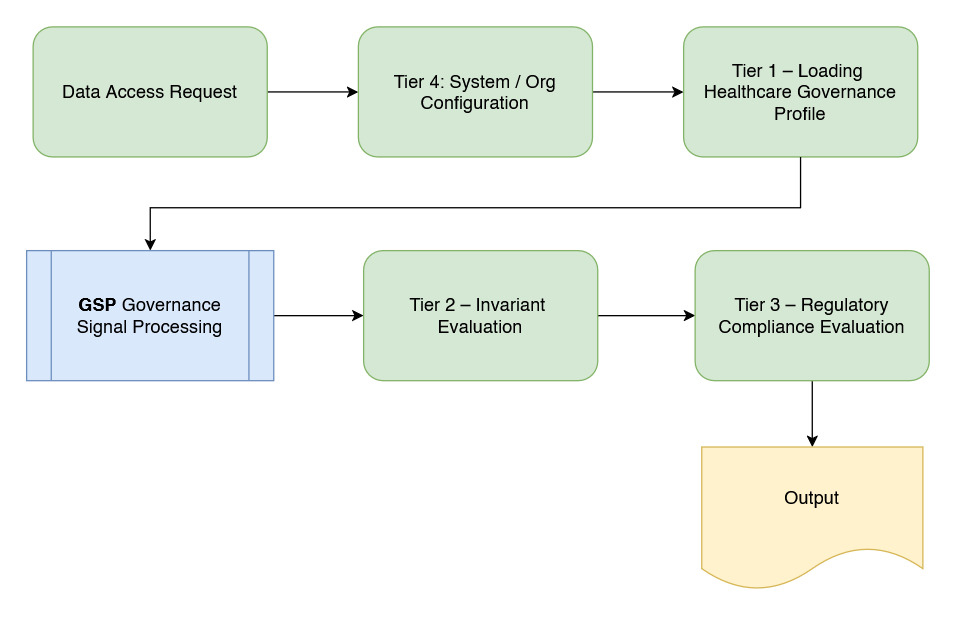
Tier 4 → Tier 1 → Tier 2 → Tier 3 → Decision
Step 1 — Data Access Request
A request for patient data is generated. Example request:
Requester: Radiology AI model
Purpose: Tumor detection
Requested Data:
- MRI scans
- patient age
- medical history
Patient Consent: AI diagnostic assistance allowed
This request becomes the input context package for QGI.
Step 2 — Tier 4: System / Org Configuration
This is the preflight defined by the orgnization. It answers: “Is this action even
allowed to enter governance evaluation?”
This is not ethical reasoning. It is hard allowlist/blocklist logic.
Step 3 — Tier 1: Healthcare Governance Profile
Healthcare is classified as a high-risk and sensitive data domain. Tier 1 loads the
Healthcare Governance Profile. For example, some signals could be:
τ_SI = 0.18: Safety / Harm Invariant (extremely strict)
τ_TI = 0.35: Transparency / Veracity Invariant (prevent biased or discriminatory outcomes )
HO = YES: Human Oversight is required
DISC = YES: Transparency disclosure required
This profile ensures that:
- patient harm risk must be extremely low
- AI reasoning must be explainable
- unnecessary data cannot be accessed
- system behavior must remain stable over time
- patients must be informed about AI involvement
Step 4 — Governance Signal Processor(GSP)
GSP extracts governance signals from the input context package, preparing signals
that Tier 2 will evaluate.
Signal extraction may use:
- statistical models
- security scanners
- logging metrics
- formal validators
- structured risk frameworks
Step 5 — Tier 2: Invariant Evaluation
Tier 2 evaluates the request against governance invariants. Example invariant checks:
- Autonomy Invariant: Does patient consent cover AI analysis?
- Non-Harm Invariant: Could the requested access create potential harm?
- Data Minimization: Is every requested field necessary?
Tier 2 reduces the request scope to the core.
Step 6 — Tier 3: Regulatory Compliance Evaluation
Tier 3 verifies regulatory compliance. Examples include:
- HIPAA data protection rules
- GDPR patient rights
- hospital governance policies
- national healthcare regulations
If regulatory violations are detected, the request is rejected, or sent to human audit.
Step 7 — Governance Decision Output
The system generates one of three outputs.
Allow:
- Access granted to MRI scans
- Medical history restricted
Conditional Allow:
- Access granted with anonymization
- Audit log created
- Human review required
Deny:
- Consent scope violation
- Request rejected
System Flow Chart
The system process may flow as the following. The real-time flow can be desiged per local conditions.
Operational Benefits
The system introduces several structural improvements.
- Deterministic Governance. Governance is enforced computationally rather than through policy interpretation.
- Reduced Data Exposure. Access is restricted to only the minimum necessary data.
- Regulatory Assurance. Compliance requirements are evaluated automatically.
- Patient Trust. Patients can be informed that their data is protected by computational governance enforcement.
Strategic Importance
Healthcare AI is expanding rapidly, but governance systems have not evolved at the same pace. Sensitive patient data requires protection mechanisms that operate at system runtime rather than through static policy documents.
The QGI Patient Data Governance system demonstrates how deterministic governance architectures can protect both human rights and AI integrity in real-world healthcare infrastructure.