
The Project: Portfolio Hiring AI. A revolutionary application of QGI that replaces biased resumes with scenario-based work simulations and objective capability metrics.
QGI governs AI in real time by validating actions, evaluating outputs against policy, resolving conflicts, and enforcing compliance—ensuring controlled, transparent, and auditable decisi
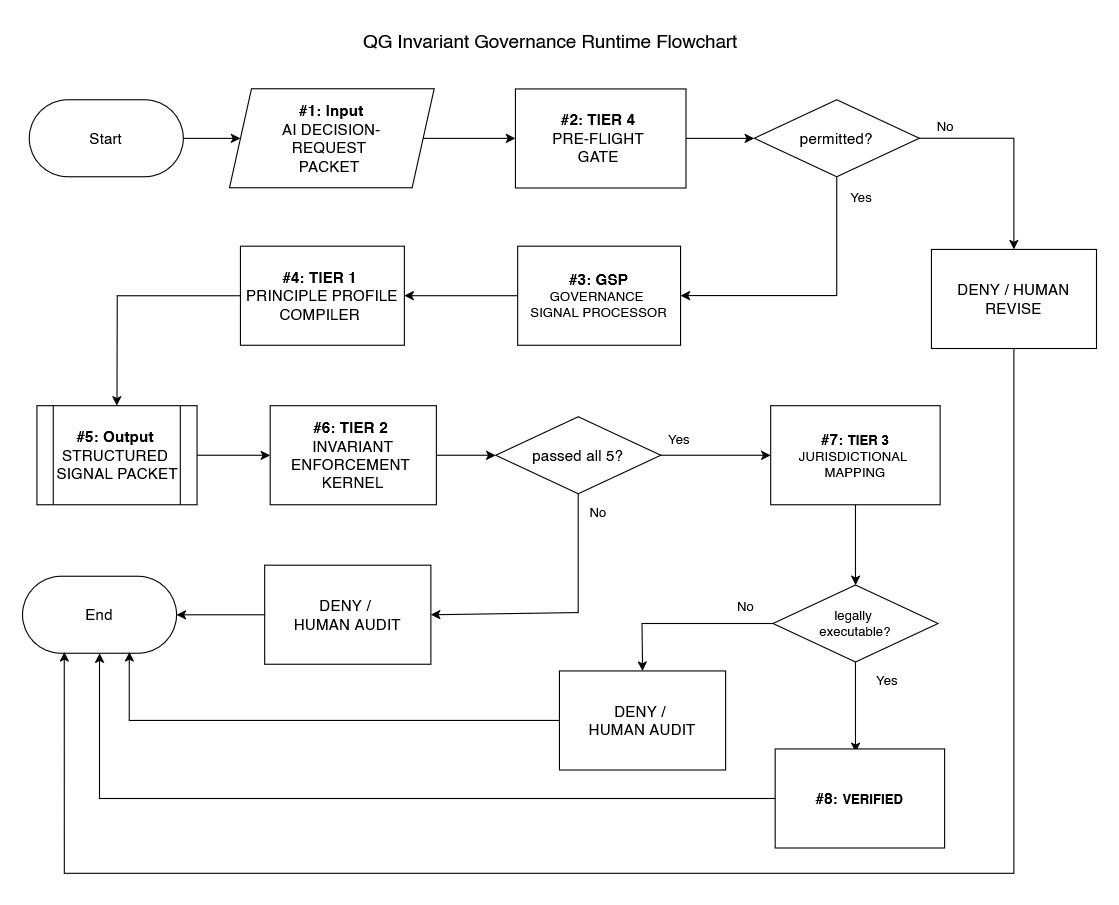
QGI operates as a governance layer that runs alongside AI systems. It does not replace AI models—it controls how they behave, ensuring every decision is evaluated, constrained, and auditable.
These steps are tiered structure. Each are mandatory. In the imbedded implementation, the steps can be scattered and repeated within AI operation, depending on the need. Tier 2 can be configured, and invariant evaluation can be separated into the process.
A request enters the system (e.g., evaluating a candidate, generating a
recommendation, or making a prediction).
The AI model prepares to process:
Before the AI executes, QGI checks:
If the request violates scope (e.g., uses restricted data or performs an unauthorized action), it is blocked immediately.
Load the governance configuration for a given context, including risk tolerance, thresholds, and control requirements. In other words, configure the required governance profile. This includes at least the following:
Tier 1 defines the governance profile—how strict the system should be and what limits must be enforced.
QGI analyzes the AI output in real time by measuring it across six governance areas:
Each area is converted into a measurable score and compared against predefined thresholds.
Once a final action is selected, QGI translates it into required obligations:
During Tier 2 execution, if no acceptable decision exists, QGI activates its Meta-Alignment process:
This ensures decisions remain controlled even in complex or conflicting situations.
The final output is a Validated Execution Payload that serves as a
legally-defensible record of the transaction.
By the time the flow reaches Tier 3 (Regulatory Mapping), the system has
cross-referenced the operational decision against specific legal statutes.
The final result includes:
QGI continuously monitors:
If risks increase, the system triggers re-evaluation or human oversight.
This is the visual expression of the execution steps. The blocking process can be customized for human audit.
QGI ensures that every AI decision is:
This transforms AI governance from a manual process into a continuous, operational system.
The Project: Portfolio Hiring AI. A revolutionary application of QGI that replaces biased resumes with scenario-based work simulations and objective capability metrics.

QGI Use Case: Commercial Loan Assessment Engine. The project is designed as a deterministic AI engine using QGI 4-tier governance to transform business lending.

The Practice: Industry Use Cases. Exploring the deterministic resolution of high-stakes challenges in Healthcare, Finance, and Public Policy.