QGI Quantified Benefits
QGI deterministic governance architecture reduces compliance complexity, code duplication, monitoring overhead, and regulatory update costs across large AI systems.

Large institutions operating under strict regulatory oversight can spend tens of millions annual cost on AI governance: auditing, and compliance infrastructure. The QGI architecture reduces these costs by embedding deterministic governance constraints directly into AI decision systems. The following quantified estimates illustrate how this architectural shift can reduce operational complexity and governance expenditures. These calculations are estimated based on large organizations operating under strict regulatory environments, typically:
- Public sector agencies within the European Commission
- Healthcare networks like Kaiser Permanente
- Global financial institutions such as JPMorgan Chase
- Canadian public health care
Quantified Benefits
These estimates compare QGI with current governance approaches used in large AI deployments (typical stacks combining policy rules, monitoring, legal review, and post-hoc audits).
1. Compliance Cost Reduction
Traditional AI compliance relies on large manual review processes, legal interpretation cycles, and repeated documentation updates. Typical enterprise cost structure:
- Compliance staff: ~6 specialists
- Average salary (loaded): $140,000
- Annual cost: 6 × $140,000 = $840,000
With QGI:
- Compliance logic is encoded in deterministic invariant gates.
- Regulatory mapping is handled automatically in Tier 3.
- Estimated reduction in manual compliance workload: 40–60%.
Estimated savings: $840,000 × 50% ≈ $420,000 per year
2. Audit Cost Reduction
AI audits normally require: external consultants, model documentation reconstruction, and manual traceability analysis. Typical enterprise audit cycle:
- External audit team: $150k–$300k annually
- Internal preparation time: ~$120k equivalent labor
- Total typical cost: ~$420,000 per year
QGI produces automatic audit artifacts:
- invariant evaluation logs
- governance decision traces
- jurisdiction mapping records
- Audit preparation effort decreases by 60–70%
Estimated savings: $420,000 × 65% ≈ $273,000 annually
3. Incident Risk Reduction
AI governance failures often create expensive operational incidents. Common examples:
- harmful automated decisions
- privacy violations
- unauthorized tool actions
- regulatory non-compliance outputs
-
Average cost of a moderate enterprise AI incident: $1M – $5M.
- Typical frequency without strong governance: 1 incident every 2–3 years
- Expected annualized risk exposure: $2M ÷ 2.5 ≈ $800,000 per year
QGI blocks unsafe actions before execution via invariant gates.
Estimated reduction in incident probability: 60–75%.
Risk reduction value: $800,000 × 65% ≈ $520,000 annual risk avoided
4. Legal Liability Reduction
Legal exposure often arises when organizations cannot prove: why an AI decision occurred, what data influenced the decision, and whether proper oversight existed. Without explainable governance, companies may face:
- regulatory penalties
- civil lawsuits
- reputational damage
- Typical annual legal risk reserve for AI programs: $500k – $1M.
QGI provides deterministic governance evidence:
- decision traceability
- invariant evaluation records
- jurisdiction compliance artifacts
Estimated legal exposure reduction: 30–50%
Estimated benefit: $750,000 × 40% ≈ $300,000 annual risk reduction
5. Model Transparency (Operational & Regulatory Benefit)
Transparency is a core governance requirement because organizations must be able to explain:
- how an AI decision was produced
- what constraints governed the system
- whether the system followed regulatory requirements
Traditional AI systems struggle with transparency because model reasoning is opaque, policy enforcement occurs outside the model, also, explanations are reconstructed after the fact.
QGI introduces structural transparency by design. Every AI action passes through:
- Tier 4 — Capability Gate verifies allowed tools and data..
- Tier 1 — Principle Profile loads strictness thresholds and governance priorities..
- Tier 2 — Invariant Evaluation mathematically checks safety, autonomy, transparency, benefit, and lifecycle stability..
- Tier 3 — Jurisdiction Mapping produces regulatory compliance artifacts..
This architecture produces deterministic governance traces for every decision. Benefits of built-in transparency:
- regulators can see exactly why an action was allowed or denied
- auditors can verify governance enforcement mathematically
- organizations gain instant compliance evidence
There are also Operational benefits, including: faster regulatory approval, easier AI certification, and reduced audit friction.
Estimated cost savings from transparency automation: $150,000 – $300,000 annually
6. Governance Automation Efficiency
Traditional AI governance relies on: policy committees, model review boards, and human oversight checkpoints. This slows deployment and increases operational cost. Typical governance overhead:
- 10–15 staff involved in review cycles
- multiple approval meetings
- weeks of delay per model deployment
- Estimated annual operational cost: ~$1.2M governance overhead
QGI automates governance enforcement in runtime.
Estimated workload reduction: 35–50%
Estimated benefit: $1.2M × 40% ≈ $480,000 per year
7. Monitoring & Model Drift Control
AI systems normally require extensive monitoring infrastructure to detect: model drift, unintended behavior, and regulatory violations. Typical enterprise monitoring stack cost:
- monitoring tools
- observability platforms
- data science monitoring staff
- Estimated annual cost: $400k
QGI reduces monitoring complexity because:
- invariant gates enforce safe boundaries
- lifecycle thresholds detect drift conditions
- unsafe states trigger automatic escalation
Monitoring workload reduction: 30–40%
Estimated savings: $400,000 × 35% ≈ $140,000 annually
8. Deployment Speed Improvement
Governance review often slows AI deployment. Typical deployment cycle:
- model readiness review
- compliance validation
- legal sign-off
- documentation generation
- Average delay per model: 2–6 weeks
For organizations deploying 20 models per year, delay costs include: lost productivity, delayed revenue impact, etc. Estimated cost of deployment friction: ~$600,000 annually.
With QGI:
- governance enforcement occurs automatically
- compliance artifacts are generated at runtime
- approval cycles are shortened
Estimated deployment acceleration: 30–50% faster.
Estimated productivity gain: $600,000 × 40% ≈ $240,000 per year
Total Estimated Annual Savings
For a typical enterprise that operates with sensitive data, this is the summary table for total savings.
| Governance Category | Estimated Value |
|---|---|
| Compliance cost reduction | $420,000 |
| Audit cost reduction | $273,000 |
| Incident risk reduction | $520,000 |
| Legal liability reduction | $300,000 |
| Transparency automation | $200,000 |
| Governance efficiency | $480,000 |
| Monitoring savings | $140,000 |
| Deployment acceleration | $240,000 |
| Total Estimated Benefit | ≈ $2.57 million per year |
The Bar Chart of the Comparison
The above text can be expressed in a visual chart. The amount of dollars is in $K.
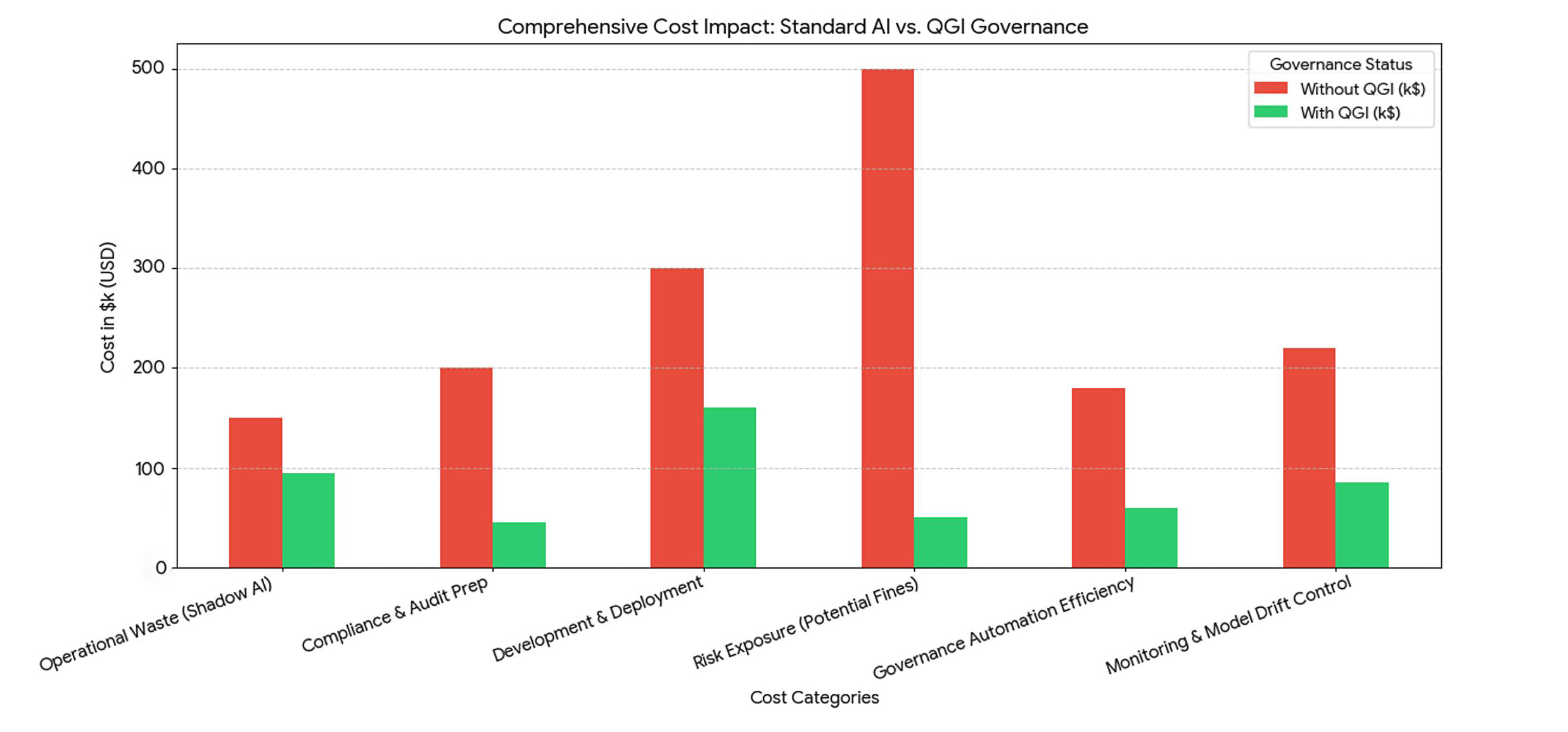
The chart highlights the dramatic shift from reactive to proactive AI management through the QGI framework:
- Massive Risk Reduction: Slashes potential fine and liability costs by 90% by blocking non-compliant outputs in real-time.
- Operational Efficiency: Cuts compliance and audit labor by ~75% through automated, deterministic record-keeping.
- Governance Automation: Reduces administrative overhead by replacing manual oversight with a lightweight, high-speed execution layer.
- Drift & Quality Control: Lowers long-term maintenance costs by catching model inconsistencies during execution rather than post-failure.
Strategic Implication
Most AI governance frameworks focus on documentation and review processes. QGI transforms
governance into runtime infrastructure. Instead of asking:
"Was the AI system compliant after deployment?"
QGI enforces a stronger guarantee: Non-compliant AI actions cannot execute.
This shift from audit-based governance to invariant enforcement produces measurable improvements in cost, safety, transparency, and regulatory readiness.